ALL ACCOR

ALL ACCOR
Book, stay, enjoy. That's ALL.com
Showing posts with label predictions. Show all posts

Saturday, 11 July 2026

Leading California wine regions at risk

Global warming and increasing wildfire risk threaten viability of elite wine-growing regions in California - but others may boom, a new report says. 

Mendocino and Monterey could become increasingly favourable for premium vintages under shifting climate patterns, while Napa and Sonoma may face increased pressure in grape cultivation. 

The US is the fourth-largest wine-producing country by output volume, and approximately 80% of its production occurs in California. 

Since the 19th century, California’s premier wine-growing regions have been the Napa Valley and Sonoma County, thanks to their favourable microclimates. 

But grape yield and quality are very sensitive to the local environment, which means that the climate crisis could shake up California’s wine industry. 

The new study shows that established regions including Napa and Sonoma could struggle to sustain their wine production under severe climate change. Others, like northern and coastal California, could become new wine-growing powerhouses.

“Our findings reveal that the outlook for Mendocino and Monterey is uniquely promising because of a dual trend: they are projected to experience both increasing climatic suitability for wine-growing and a decrease in extreme fire-weather days,” said Dr Yusuke Hiraga, an assistant professor at Tohoku University in Sendai, Japan, and author of the study in Frontiers in Climate. 

“This combination makes these areas stand out as comparatively favourable expansion zones, distinct from many other regions with either rising suitability alongside increased wildfire weather or declining suitability

Together with Takuya Matsumoto, a masters student at Tohoku University, Hiraga modeled California’s current and future climatic suitability for wine grape cultivation. 

They focused on 379 wine-growing locations listed in the California Wine Institute, predominantly in the North Coast region and across the Central Coast.

To forecast climate change, the authors mapped projections from global climate models onto a 4km-by-4km grid across the mainland US. 

They also considered alternative carbon emission scenarios. 

The authors likewise modelled the shifting weather conditions linked to wildfire risk and expected severity within each cell. 

The results showed that the suitability of currently important wine-growing regions, like Napa, Sonoma, San Luis Obispo, and Santa Barbara, is likely to decline strongly under severe climate change. 

In contrast, suitability was predicted to increase greatly in Mendocino, Monterey, and in central to southern coastal areas. 

“While our study highlights long-term shifts in climatic and fire-weather suitability through the end of the century, it does not attempt to predict a specific timeline for when emerging areas will surpass currently established regions in wine-growing potential,” Hiraga said. 

“Such a precise forecast is complex, as the future of viticulture is shaped not only by climate change and wildfire weather but also by a wide array of anthropogenic factors.”

For more info, here is the original research  article: https://www.frontiersin.org/journals/climate/articles/10.3389/fclim.2026.1838268/full

Wednesday, 14 May 2025

It's official: tourists are avoiding the US

It is official. Travellers are voting with their wallets and avoiding the US.

The World Travel & Tourism Council is forecasting a significant decline in tourism spending by international travellers to the US this year, media hub Travel Mole reports.

The WTTC predicts a drop of up to $US 12.5 billion in travel revenue in 2025.

That could potentially put nearly 100,000 tourism jobs at risk, it says .

The WTTC study, in conjunction with tourism data partner Oxford Economics, estimates that tourism receipts will fall below $169 billion by the end of 2025.

That marks a decline of about 7% with numbers down by 22% on 2019 levels.

The WTTC says it is the only nation out of 184 global economies analysed that is expecting a decline in tourism revenue this year.

“Other countries are really rolling out the welcome mat, and it feels like the US is putting up a ‘we are closed’ sign at their doorway,” says WTTC president and Chief Executive Officer Julia Simpson.

“The US travel and tourism sector is the biggest sector globally compared to any other country, worth almost $2.6 trillion.”

Taking into consideration direct and indirect spending it represents about 9% of the US economy and employs 20 million people.

The WTTC says traveller sentiment has shifted due to the political rhetoric of the Trump Administration and stories of travellers being held at immigration for sometimes spurious reasons.

“What we are seeing now is a sentiment shift that’s really very sad,” Simpson said.

“Legislators need not confuse the tourism sector with issues around illegal immigration. A sophisticated system can balance both without turning the country into an island that no one wants to visit.”

The latest tourism data for March 2025 shows a decline in arrivals for all of the US’s major source markets.

Germany arrivals are down 28% and the UK 15% year-over-year.

There are also significant declines from South Korea, Spain and Ireland.

The WTTC now thinks US tourism won’t fully recover to pre-pandemic levels until at least 2030, even with the America 250 celebrations next year, the FIFA World Cup and the Olympics.

The British-based WTTC is a non-profit membership-based organisation

Monday, 16 September 2024

French wine production figures tumble for 2024 vintage


So you love French wines and are keen to buy them as cheaply as possible?

Sorry, the news is all bad with production figures for the 2024 vintage tumbling by 18% year-on-year and 11% against a five-year average, potentially creating a supply shortage.

Figures from the French government’s agricultural statistics department paint a bleak picture for wine lovers, news website drinks business reports.

Wine production is estimated to be 39.3 million hectolitres in 2024, Agreste, the statistics and forecasting department of the Ministry of Agriculture and Food, says.

This would make it one of the lowest years for production since the World War II, when the industry was recovering, and one of the smallest harvests in a century. Not since 1957 has production been this low.

The decline is due to particularly unfavourable weather conditions that have reduced production potential in almost all wine-growing areas. 

The most significant declines concern the vineyards of Jura, Charente, the Loire Valley and Beaujolais/Burgundy, Agreste reported.

Episodes of frost and hail have also been reported.

The data agency reported decline is expected in almost all regions, including Champagne and Burgundy.

In Alsace, wine production would drop by 30% compared to last year, while Bordeaux is expected to fall by 10%, after an already reduced harvest in 2023.

Tuesday, 15 August 2023

Australian wine industry still faces a major problem

Even the early removal of Chinese tariffs on wines imported from Australia would not be enough to prevent the wine industry facing several years of oversupply, a new report preidcts.

Rabobank's Wine Quarterly Q3 2023 report says that improved trade relations between the two countries and the recent removal of Chinese tariffs on Australian barley has led to optimism that five-year tariffs placed on Australian wine in March 2021 may be removed early.

But the Rabobank report says even in a “best case scenario”, with tariffs removed this year and Chinese consumption of Australian wine recovering quickly, this would “not be a panacea” with Australia’s wine industry still facing at least two years to work through its current wine surplus.

While this isn’t good news for Australian wine makers, there is an upside for consumers, says the report author: RaboResearch associate analyst Pia Piggott (image).

She says the oversupply is keeping prices of many quality Australian red wines at reduced levels.

So large is the current oversupply, says Piggott, that Australia has the equivalent of 859 Olympic-sized swimming pools worth of wine in storage.

"That’s over two billion litres of wine, or over 2.8 million bottles of the wine,” she said.

The Rabobank report says Chinese anti-dumping tariffs placed on Australian wine had led to significant disruptions for Australia’s wine industry, with Australia’s value of exports decreasing 33% over the past two years.

Piggott said with the tariffs coinciding with significant growth in Australian production and logistics bottlenecks from Covid, the Australian wine industry is now dealing with inventory oversupply which is depressing prices - particularly for commercial red varieties.

“Driven by sustained economic growth, rising incomes as well as the social status of wine drinking and gifting, global wine imports to China grew at an impressive 18% compound annual growth rate (CAGR) in the decade up to 2017 elevating China to be a top five wine importing nation globally,” she said.

“In the four years following the China-Australia Free Trade Agreement in 2015, the tariff on Australian wine reduced from 14% to zero %, helping to double Australia’s market share in China from 12% to 24%.

“When a slew of Chinese anti-dumping tariffs and soft bans hit various products exported by Australia in 2020-2021, wine took the most notable hit, losing about one third of export value from its peak in 2019.

“Unluckily, the tariff coincided with an exceptional growing season - and Australia’s largest crush on record.” 


Wednesday, 9 March 2022

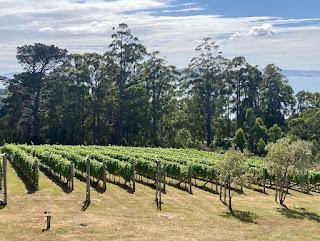
Tasmanian wine vintage gets started


Other regions of Australia may have already finished harvesting grapes but in cool-climate Tasmania the 2022 vintage is only just starting and will continue for several weeks.

The first grapes - destined for sparkling wine - are gradually being harvested from the island’s warmer vineyards, and early reports fro­m wine producers in terms of quality are very positive.

Intermittent cool weather and rain events in some areas have slowed the ripening process of grapes, meaning that the season is slightly behind its usual timing.

Reports from across the state indicate that quality to date is very high, although some southern vineyards suffered hail damage late last year.

Contrasting predictions regarding the quantity of grapes likely to be harvested from different areas - influenced predominantly by cool spring weather - has reflected the diversity of the island’s microclimates. 

Despite this variability, general predictions are that yields will be in line with medium-term averages.

"No two seasons are the same in Tasmania and this year is certainly, yet again, highlighting this fact," says Wine Tasmania CEO Sheralee Davies

"The Tassie wine region has a cool and variable climate, which brings exceptional quality but also great risk. Our growers and winemakers work tirelessly to expertly manage seasonal conditions and produce the best possible wine each vintage.

"Tasmania has successfully built a global reputation for its outstanding wines, as reflected in the value of our grapes (4.5 times the national average) and bottled wine (double the country’s average). Despite Covid-19 challenges and border closures, visitation to the island’s cellar doors remains strong, with 25% of visitors to Tasmania (160,000 people) choosing to include a cellar door experience in their itineraries last year.”

While cooler conditions have created challenges, so too have the few short periods of warm weather experienced in the state, which bring the risk of fires and smoke. Vineyards are particularly susceptible to smoke exposure, which can irreparably damage wine grapes and the livelihood of wine producers for the full season and their year's efforts.

“The potential impact of smoke is one of the greatest concerns for wine producers at this time of the year, who will continue to harvest for several months through to the end of May," Davies said.

"We encourage anyone planning to light a fire on a residential or commercial property in the months ahead to consult with the Tasmania Fire Service and nearby vineyards before igniting their burn to ensure they don't inadvertently cause major damage.

“The thousands of people across the Tasmanian wine community do what they do because they truly believe this little island is among the best places on the planet to produce outstanding wine. Lovers of Tasmanian wine can look forward to tasting the rewards of the 2022 Tasmanian vintage over the coming months and years.”

Image: Resolution Vineyard, Middleton